• Capture

    By Stacy Palen

    Don’t forget to remind your students about the Eta Aquariid Meteor Shower, coming in the beginning of May.  The peak occurs around May 4-5.  This is the last chance for most of us to remind Spring semester students to go out and watch a meteor shower!

    This meteor shower occurs when Earth passes through the debris left behind by Halley’s Comet.  Particles lost from the comet continue to drift in the Solar System, gradually changing their position. As Earth moves through space, it passes near the trajectory of the comet and runs into collections of these particles.  The particles burn up, creating meteors as they fall through the atmosphere. This will happen repeatedly at particular times of year, as Earth returns to the same point in its orbit. 

    Halley’s comet has a 76-year orbit, so it is a short-period comet. It will not be back in the inner Solar System until 2061.

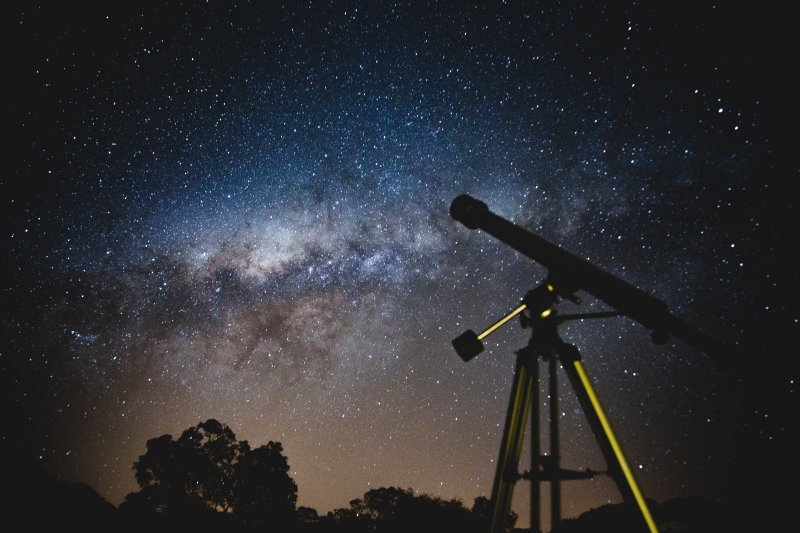
    To watch a meteor shower, go to a clear dark sight where the horizon is not obstructed.  Spend about half an hour in the dark, without your cell phone or other bright light in view.  This will allow your eyes to adapt to the dark. Then just watch for meteors!  They are best seen with the naked eye.

    If you are careful and methodical, your observations can contribute to the study of meteors and meteor streams!  To learn more, visit the Astronomical League’s Meteor Observing Program website.

  • Meteor Shower

    Image Credit: NASA/Bill Ingalls

    By Stacy Palen

    Don’t forget to remind your students to watch for the Lyrid Meteor Shower this month. The peak occurs around April 21-22.

    This meteor shower comes as Earth passes through the debris left behind by Comet Thatcher. Particles lost from the comet continue to drift in the Solar System, gradually changing their position.

    As Earth moves through space, it passes near the trajectory of the comet and runs into collections of these particles. This will happen repeatedly at particular times of the year as Earth returns to the same point in its orbit. The particles burn up, creating meteors as they fall through the atmosphere.

    Comet Thatcher has a 415 year orbit, so it is a long-period comet. It will not be back in the inner Solar System until 2276.

    To watch a meteor shower, go to a clear dark site where the horizon is not obstructed. Spend about half an hour in the dark, without your cell phone or other bright light in view. This will allow your eyes to adapt to the dark. Then just watch for meteors! They are best seen with the naked eye.

    If you are careful and methodical, your observations can contribute to the study of meteors and meteor streams! To learn more, visit the Astronomical League’s Meteor Observing Program website.

  • By Stacy Palen

    My students came in talking about this, and so I thought I’d pass on a couple of resources that I used while answering questions in class! 

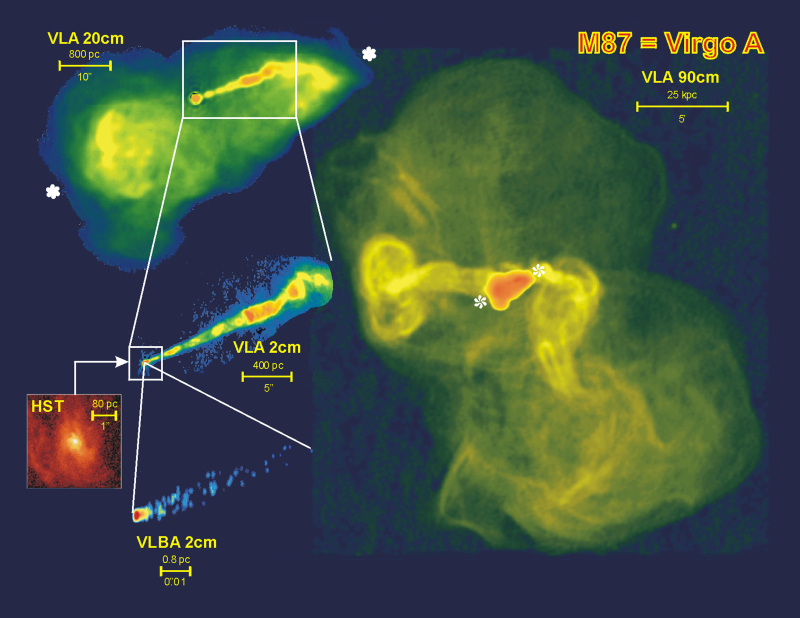
    I felt I needed to put the new image in context, with respect to M87 and all its fascinating parts.  This photo has the angular sizes labeled, as well as the wavelengths of the observations. It’s a quick place to get all those numbers right away.

    HRJM5E

    ESO has an image of the global array: https://www.eso.org/public/images/ann17015a/

    Veritasium has a nice short explainer video about the light paths:

    https://www.youtube.com/watch?v=zUyH3XhpLTo&app=desktop&fbclid=IwAR21-0tZfhk111J90A2z4wje8BXYEs9bnOaaB_7Fselx1D79S4aGCzIt2Oo

    Which then matches beautifully onto the actual image and has some fun information about the technical difficulties with data transfer etc.:

    https://www.bbc.com/news/science-environment-47873592?fbclid=IwAR295qFGm9R_P3kGokpDYRbmiaPPs6R5zFfvQdbXq5sIsNDytAuswqg-6JQ

    I made a point of taking them to the summary research paper:

    https://iopscience.iop.org/article/10.3847/2041-8213/ab0ec7

    Both so that they could just see it, but also because I wanted to show the author list and acknowledgements. This is an important thing that science does: model how to have international collaboration. The paper summarizes the achievement nicely: “In conclusion, we have shown that direct studies of the event horizon shadow of supermassive black hole candidates are now possible via electromagnetic waves, thus transforming this elusive boundary from a mathematical concept to a physical entity that can be studied and tested via repeated astronomical observations.”

    We happen to have just done two of the Learning Astronomy by Doing Astronomy activities about black holes: Bent Space and Black Holes, and Light Travel Time and the Size of a Quasar. So, this was a lucky moment when we were all thinking about these concepts anyway!

  • Astrology-astronomy-constellation-2034892

    By Dr. Bradley W. Carroll

    We live at a unique point in history. For the first time, we humans know the entire story of our species, at least in broad outline. We know how the universe expanded from the initial Big Bang, how generations of stars manufactured a periodic-table’s worth of elements and then dispersed them throughout space as those stars exploded, and how clouds seeded with those elements gravitationally collapsed to form planets. We understand the evolution of the life that arose on this particular planet, and how an astronomical impact led to the dominance of the hairless apes that eventually became our friends and neighbors.

    But what was it like to be alive four centuries ago when almost everything was a mystery? What was it like to discover, for the very first time, that the Moon has mountains, that there is a universe filled with stars we cannot see with the naked eye, and that other moons orbit Jupiter? Fortunately, we know exactly what it was like because the man who made these discoveries has told us: Galileo Galilei.

    Sidereus Nuncius (The Starry Messenger) is not filled with the dry dialectics of Galileo’s other tomes. In this book you can sense Galileo’s exuberance, his sense of wonder at what he has seen for the very first time through the crude telescope he made with his own hands. He tells you how he labored over its construction until he could see objects “over sixty times larger.”

    Galileo writes that “having dismissed Earthly things, I applied myself to explorations of the heavens.” He grabs your sleeve to pull you toward his eyepiece so you can see these wonders for yourself.

    And what wonders they were to his eyes! Galileo sees the tops of mountains on the Moon lit by the Sun, and asks us, “On Earth, before sunrise, aren’t the peaks of the highest mountains illuminated by the Sun’s rays while shadows still cover the plains?” Galileo alone now knows that the Moon is not a perfect sphere. Using shadows, he calculates that one lunar mountain is “higher than 4 Italian miles.”

    Galileo swings his telescope toward the constellation of Orion, and breathlessly tells us that “to the three [stars] in Orion’s belt and six in his sword that were discovered long ago, I have added eighty others.”

    Then, on January 7, 1610, Galileo trains his telescope on Jupiter to see “three little stars” near Jupiter that are “arranged exactly along a straight line and parallel to the ecliptic.” Night after night Galileo keeps track of these stars, now grown to four, as they stalk Jupiter, passing back and forth across its disk.

    Finally, on March 2, Galileo calls them “planets,” and later, the “Medicean planets.” (In the opening passages of Sidereus Nuncius, Galileo, in his never-ending quest for patronage, proposes naming these four moons of Jupiter for Cosimo II de’ Medici, the Fourth Grand Duke of Tuscany.)

    Thirty years ago, I attended a meeting of the American Astronomical Society in Ann Arbor. There on display was a draft of a short letter Galileo sent to the Doge of Venice on August 24, 1609 that described his telescope. But at the bottom of the letter are Galileo’s first recordings of the moons of Jupiter, made on this paper he happened to have nearby.

    I felt overwhelmed knowing that when Galileo’s hand made these marks upon this sheet of paper, the world changed. Galileo now knew with certainty that Earth was not the center of the all things, because here were four moons orbiting Jupiter. Galileo went on to make more astronomical discoveries. He discovered spots on the Sun and the phases of Venus, but his Sidereus Nuncius announced his first discoveries to the world.

    Reading the Sidereus Nuncius, I am struck by encountering a fully modern mind, so different from the mysticism of Johannes Kepler. It marked a revolution. After Sidereus Nuncius, astronomy no longer had to rely on the word of ancient authority for its conclusions. Astronomy became an observational science, and anyone with a telescope could see what Galileo saw. Sidereus Nuncius is a short book, just 62 pages. My version, translated by Albert Van Helden, has useful notes along with an introduction and conclusion. Read it for yourself and be present with Galileo at the beginning of modern astronomy.


  • Adult-business-meeting-business-people-1438072

    By Stacy Palen

    Somehow or other, classroom architects in the 1960s, 1970s, and as far along as the 2010s did not get the memo that instructors would sometimes want students to work together on projects. It’s a mystery. Even in our two-year-old science building, the lecture halls are set up for presenting to large groups. This is fine, but presents a challenge when I want to have students collaborate.

    Often, I’ll put students in groups of two for brief discussion on things such as clicker questions or to work through a worksheet. “Groups” of two are easy to accomplish. But sometimes, we just need more room, either to work in groups of three or four, or to work with “manipulables” like paper moons or large maps.

    When this happens, I need an advance plan. Typically, I will need about twice as much space as I have in the seating area of the lecture hall. I’ll look for space in the front or back of the lecture hall, and down the stairs on either side of banks of chairs, and estimate how many groups of 3–4 I can fit in those areas. I will scout out nearby alternative locations for students to work, like a stairwell, outdoor retaining wall, or atrium. Sometimes there are groups of chairs at the end of a hallway, or benches outside the classroom.

    At the beginning of class, I’ll spend a few minutes on the typical introduction to the activity and the material, and then I’ll invite the students to spread themselves out to work in the spaces I’ve designated. About a third of them stay in the seating area of the lecture hall, turning backwards and kneeling in their chairs to work with the people behind them. The rest move out into the larger spaces and form into small groups.

    I spend the rest of the time walking through those spaces: interrupting groups who’ve gone off track, or who aren’t making progress, gently nudging students to ask better questions and suggesting that student X take a turn holding the paper “Moon.”

    It sounds like chaos, but it actually works out very well. One unexpected benefit is that I am harder to find. This means that students must struggle on their own a bit longer before they can ask me for help. Often, that little bit of “extra” time lets them solve their own problem.

    I’ve never had a student complain about this, nor have I heard from the professors teaching in neighboring classrooms that it has been in any way disruptive. Sometimes, they just shut their door.

    I have, on occasion, had students who are wheelchair users or whose mobility is restricted in some other way, and so I make certain to keep an eye out for any obstacles to group inclusion, physical or otherwise. Most always find a group without issue, but I do keep an eye on the situation, just in case.

    Possibly the most common question I get asked about active learning is, “How can I do this in a lecture hall?” Depending on the individual situation, it may be difficult. But take a look around—often you might find you can “rent” a little space outside the confines of the lecture hall for the fun activities you want to do!

  • Stacy Palen has created 23 videos on key topics to accompany her textbooks, Understanding Our Universe and 21st Century Astronomy, that instructors can assign as pre-class activities or show in class. A mixture of live demos and mini lectures, these videos explain key concepts in an understandable and compelling way. In the angular momentum video, Stacy stands on the “rotating platform of doom” and is given a small shove with outstretched arms, and then brings those arms in close to her body to demonstrate the conservation of angular momentum. Watch the video below and let us know what types of live demos you do in class!

  • Girl Stars1

    By Stacy Palen

    The article from Nature Ecology & Evolution, How the Entire Scientific Community Can Confront Gender Bias in the Workplace, came across my screen recently, and it occurred to me that many astronomy professors might not see it…

    I find that while evidence of gender bias is well-documented, approaches to changing that bias are harder to come by. Near the end, this article provides some scientifically-minded suggestions for tackling the gender bias problem that we may all find helpful. It’s important to note that this article is coming from the biological sciences, which statistically have a smaller gender bias problem than the physical sciences.

    As I read the piece, I was reminded of a particularly formative interaction I had as a young scientist. When I interviewed at graduate schools, I talked to lots of professors of both physics and astronomy, since I hadn’t yet decided how I would specialize.

    As an undergraduate, I had taken one subpar introductory astronomy course which didn’t make the field seem very appealing—the class primarily focused on memorizing which stars were in which constellations that were visible at what times of the year. (There was also a lot of talk about epicycles, which took me nearly two years to eradicate from my brain, in order to make room for ellipses.) So astronomy was on my radar, but only peripherally. At the time, it seemed to me that something closer to industry might be a wiser choice.

    During a visit, one professor made an off-hand comment that would alter the trajectory of my life: “Of course,” he said, “there are lots of women heroes in astronomy…” And that was it. In that moment, I decided I wanted to find out more about those women heroes, and the obvious way to do that was to specialize in astronomy and astrophysics.

    Go figure. Sometimes the smallest, most insignificant interactions can change a life…

    I’m positive that this professor doesn’t remember the interaction. I know this because I later asked if he remembered my visit (for another reason), and he didn’t recall it. I don’t blame him—I too have had former students say to me, “You said this one thing, one time, that changed my life…” and had absolutely no recollection of it. It’s difficult to know how our most off-hand interactions affect other people.

    Lately, I’ve been trying an experiment in which I include more women and minority scientists in my classes but do NOT make a big deal of pointing them out; instead, I just mention them casually, as though it happens all the time. I’m interested to see how this affects my students in the future.

    I'll have the luxury of interacting with some of these students again in later years, both in other classes in the department and across campus. And I’ll probably devise some sneaky way of asking a question on a homework or exam to find out if they noticed. I’ll let you know how it goes…

  • Pexels-photo-1274260

    By Stacy Palen

    A few weeks ago, Colin Inglefield wrote a guest post about his uses of trade books in the classroom. Over break, I finally had a chance to read Glass Universe by Dava Sobel, and I think this would make a great book to use in this context. The book is about the early years of the Harvard Observatory, and the women “computers” who worked there. I am considering using this text for Astro101 next fall.

    There are several themes running through the book that might be used to guide discussion throughout the semester.

    The first is the science and society angle; there’s a lot to talk about here, of course, about the role of women in science, and how the larger society’s norms decide who gets to play along in the sciences, and in what role. Then there’s the question of who gets the credit. In recent years, it has become increasingly well-known that Rosalind Franklin was robbed of recognition for her critical involvement in the discovery of DNA due to her gender. Sobel tells a parallel story in astronomy about Cecilia Payne-Gaposhkin, and her 1925 thesis that began a revolution in astronomy by discovering that stars have fundamentally different compositions than planets. Why is her name not as well-known as Chandrasekhar’s? That’s an opening point for a wide-ranging discussion about not only the role of women in science, but also general fairness (think of the recently renamed Hubble-Lemaitre Law).

    The second is about the symbiotic connection between technology and science. (This is covered more directly in another trade book, Starlight Detectives by Alan Hirshfeld.) Hirshfeld convincingly argues that the revolution in photography created a corresponding revolution in science, because scientists were able to store objective data for the first time. This meant that multiple scientists could analyze the same data, and compare data points over time. Hirschfeld follows this thread through Henrietta Leavitt’s work on different types of variable stars, Annie Jump Cannon’s work on spectroscopy, and Cecilia Payne-Gaposhkin’s work on elemental abundances, and reveals why these discoveries could not have been made in Newton’s time, for example, the record-keeping ability that photography provides simply didn’t exist. Similarly, telescope technology was improving by leaps and bounds during this time, and internally consistent observations from both hemispheres became possible.

    The third theme is about the role of private and public philanthropy in science. Most students are not aware of how science is funded today, nor how it has been funded in the past. The funding sources dictate, to some extent, what projects are pursued. At the Harvard Observatory during this time, Mary Ann Draper’s interests were decisive to the success of the observatory, and dictated to some extent the avenues of inquiry that were followed. There are benefits and drawbacks associated with privately funded science just as there are with publicly funded science. Deciding on the balance between the two funding sources is a current argument unfolding in the political sphere and in the larger society. This book helps illuminate the extent to which science in the past was dependent on the individual inclinations of wealthy donors. It’s for your students to decide whether they think the system has improved or not!

    I’ll use this book for an experiment with book discussion groups in fall semester. I’ll let you know how it goes! Let me know if you decide to try something similar.