By Stacy Palen
My students came in talking about this, and so I thought I’d pass on a couple of resources that I used while answering questions in class!
I felt I needed to put the new image in context, with respect to M87 and all its fascinating parts. This photo has the angular sizes labeled, as well as the wavelengths of the observations. It’s a quick place to get all those numbers right away.
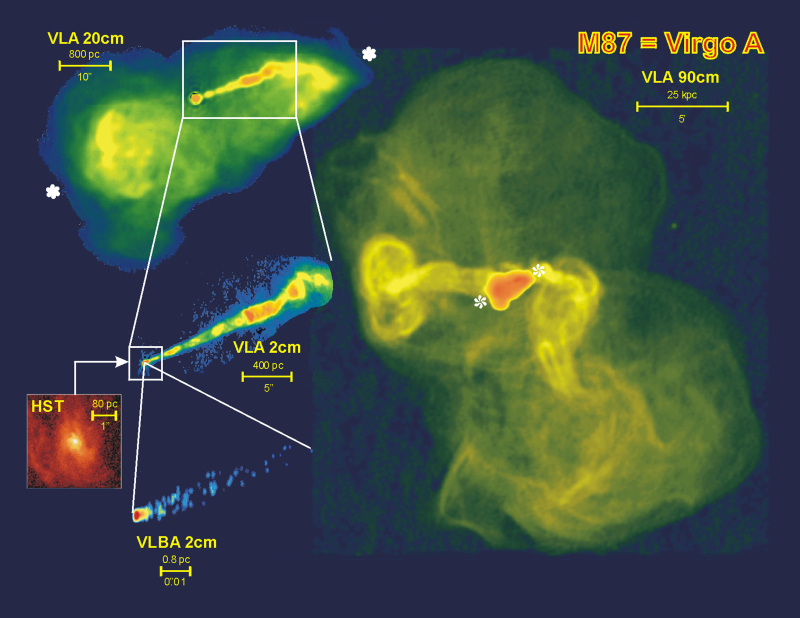
ESO has an image of the global array: https://www.eso.org/public/images/ann17015a/
Veritasium has a nice short explainer video about the light paths:
Which then matches beautifully onto the actual image and has some fun information about the technical difficulties with data transfer etc.:
I made a point of taking them to the summary research paper:
https://iopscience.iop.org/article/10.3847/2041-8213/ab0ec7
Both so that they could just see it, but also because I wanted to show the author list and acknowledgements. This is an important thing that science does: model how to have international collaboration. The paper summarizes the achievement nicely: “In conclusion, we have shown that direct studies of the event horizon shadow of supermassive black hole candidates are now possible via electromagnetic waves, thus transforming this elusive boundary from a mathematical concept to a physical entity that can be studied and tested via repeated astronomical observations.”
We happen to have just done two of the Learning Astronomy by Doing Astronomy activities about black holes: Bent Space and Black Holes, and Light Travel Time and the Size of a Quasar. So, this was a lucky moment when we were all thinking about these concepts anyway!
 Teaching Astronomy by Doing Astronomy
Leave a comment